Although fisheries sustainability in the Mediterranean and the Black Sea remains a source of concern, the percentage of overfished stocks has dropped to its lowest level in a decade, a milestone that coincides with aquaculture’s rapid expansion as a major source of aquatic foods in the region, according to a report released today by FAO’s General Fisheries Commission for the Mediterranean (GFCM).
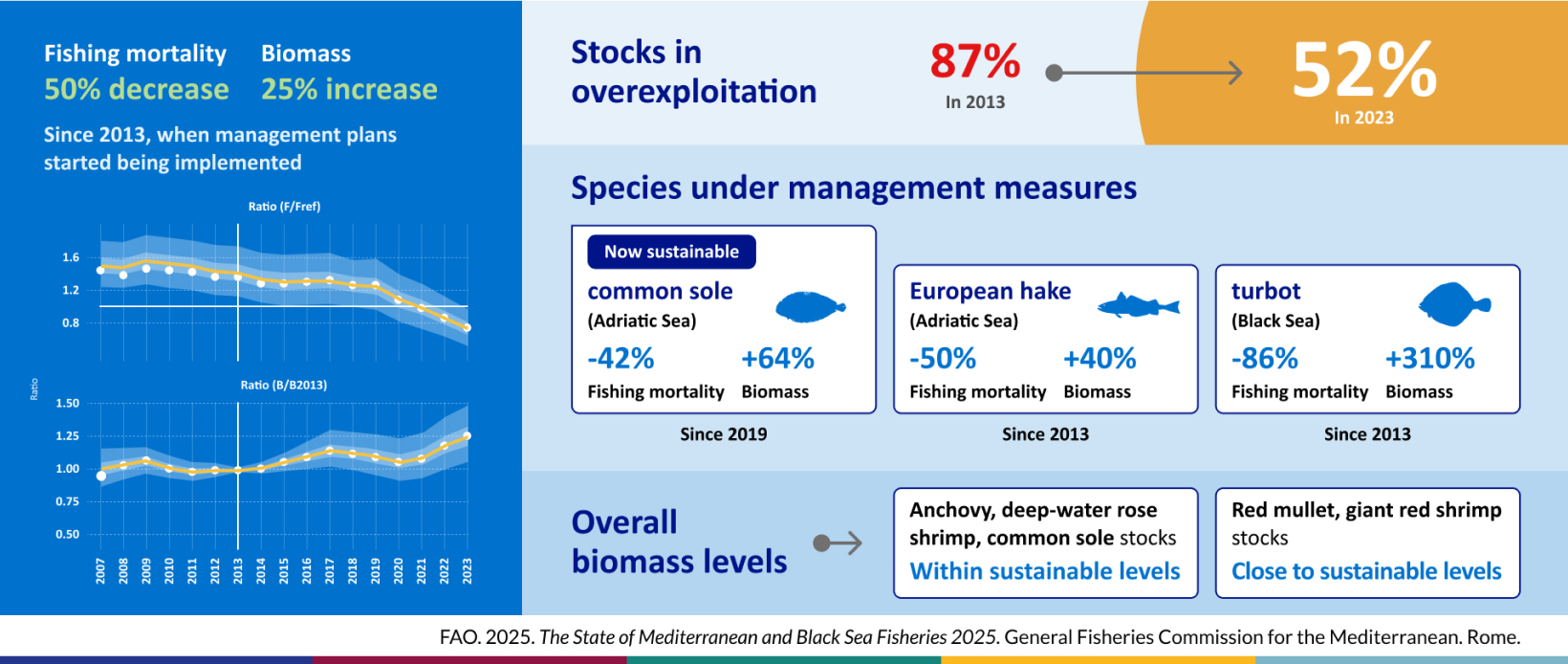
The 2025 State of Mediterranean and Black Sea Fisheries (SoMFi) report, produced with contributions from more than 700 regional experts, demonstrates that strong cooperation and evidence-based management are paying off. Fishing pressure has been cut by half over the past 10 years and key stocks are recovering.
At the same time, marine and brackish aquaculture now accounts for more than 45 percent of aquatic food production, reaching 940 000 tonnes in 2023. Together, fisheries and aquaculture and their value chain produced 2.06 million tonnes of aquatic foods, generated $21.5 billion and supported 1.17 million jobs.
“Stocks are not yet where we would like them to be, but they are beginning to recover thanks to science-driven management action and strong stakeholder engagement, while aquaculture, if done responsibly, is proving it can help meet future demand for aquatic foods,” said Manuel Barange, Assistant Director-General and Director of Fisheries and Aquaculture at the Food and Agriculture Organization of the United Nations (FAO). “Maintaining these efforts will be crucial to conserve ecosystems, strengthen livelihoods and ensure the region’s food security through what we call a Blue Transformation.”
The report, the most comprehensive to date, assesses 120 stocks across the Mediterranean and the Black Sea, indicating that between 2013 and 2023, fishing mortality fell sharply while the biomass of assessed commercial species increased by 25 percent, thanks to stronger, evidence-based fisheries management. You can read the rest of the report here.