• About Us
  • Contact Us
SUBSCRIBE
Saturday, June 6, 2026
No Result
View All Result
Green Mile
Advertisement
  • Spotlights
  • Sustainability
  • Waste Management
  • Green Innovations
  • Industries
    • Oil & Gas
    • Re-refinery
    • Maritime
    • Automotive
    • Manufacturing
    • Plantation
  • News
    • News
    • EPR Updates
    • Base Oil Update
  • eMag
  • Spotlights
  • Sustainability
  • Waste Management
  • Green Innovations
  • Industries
    • Oil & Gas
    • Re-refinery
    • Maritime
    • Automotive
    • Manufacturing
    • Plantation
  • News
    • News
    • EPR Updates
    • Base Oil Update
  • eMag
No Result
View All Result
Green Mile
No Result
View All Result
Home News

New technology eliminates “forever chemicals” with record-breaking speed and efficiency

The material works hundreds to thousands of times faster and more efficiently than current filters, even in river water, tap water, and wastewater.

rakesh by rakesh
26/12/2025
in News
0
New technology eliminates “forever chemicals” with record-breaking speed and efficiency

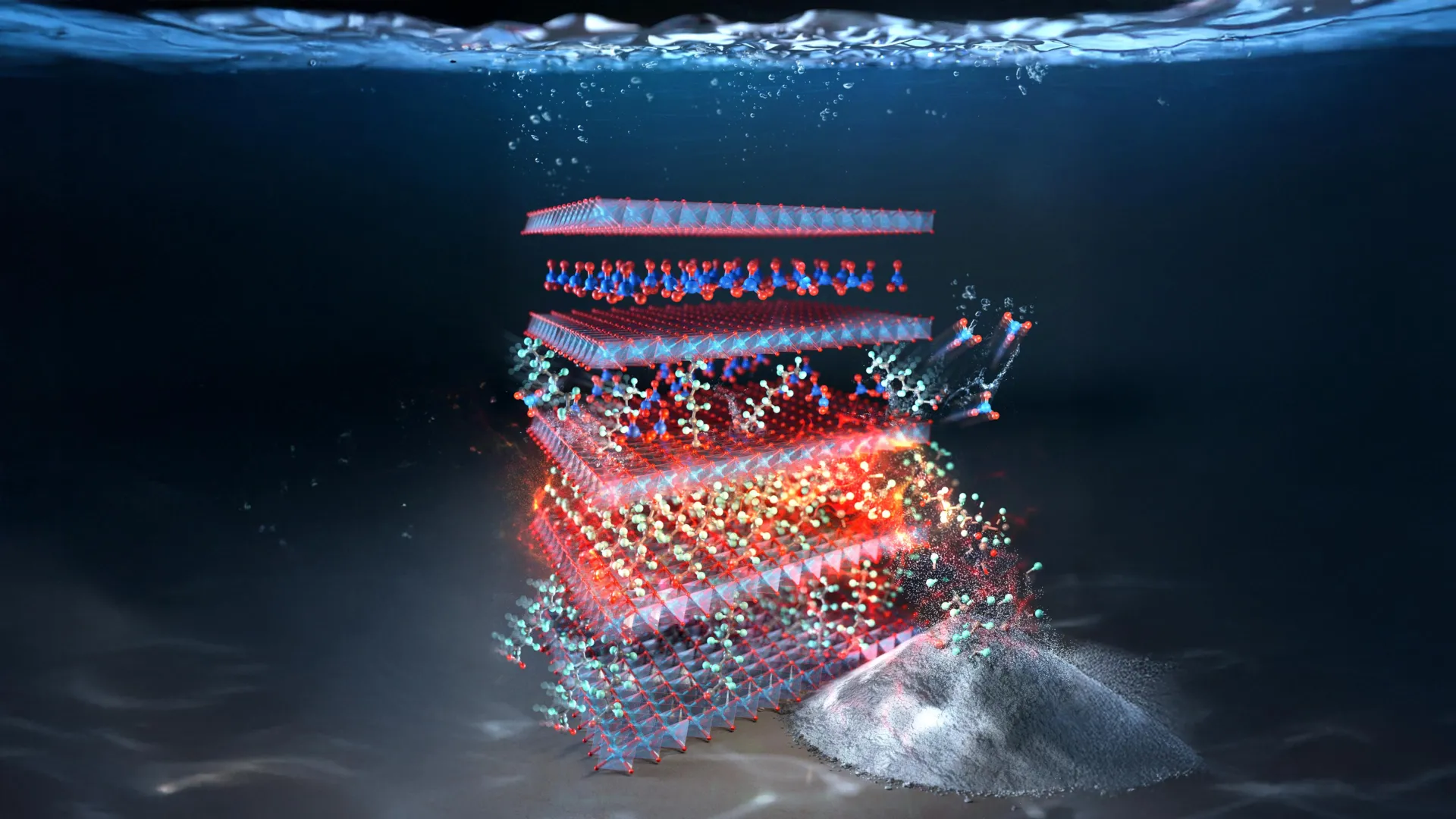
Provided image of the layered double hydroxide material made from copper and aluminum. This image was featured on the cover of Advanced Materials. Credit: Advanced Materials and Rice University.

0
SHARES
0
VIEWS
Share on FacebookShare on LinkedinShare to EmailShare to WhatsAppShare to TelegramShare to ChatGPTShare to Pinterest

A research team at Rice University, working with international collaborators, has created the first environmentally friendly technology that can quickly trap and break down toxic “forever chemicals” (PFAS) in water. The results, published recently in Advanced Materials, represent a meaningful advance against one of the most stubborn pollution threats worldwide.

The project was led by Youngkun Chung, a postdoctoral fellow mentored by Michael S. Wong, a professor at Rice’s George R. Brown School of Engineering and Computing. The effort also included Seoktae Kang, a professor at the Korea Advanced Institute of Science and Technology (KAIST), and Keon-Ham Kim, a professor at Pukyung National University in South Korea.

PFAS, short for per- and polyfluoroalkyl substances, are man-made chemicals that date back to the 1940s. They have been used in many everyday products, including Teflon pans, waterproof clothing, and some food packaging. PFAS became popular because they resist heat, grease, and water, but that same durability also means they break down very slowly, which is why they are often called “forever chemicals.”

PFAS have now spread widely and can be found in water, soil, and air around the world. Research has linked exposure to liver damage, reproductive disorders, immune system disruption, and certain cancers. Cleanup has been difficult because once PFAS enter the environment, they are hard to remove and even harder to destroy.

Read more here.

Previous Post

Japan to back clean-energy users with $1.3 billion in investment subsidies

Next Post

Oceans are supercharging hurricanes past Category 5

rakesh

rakesh

Related Posts

Decarbonisation a ‘critical corporate priority’ for Mitsubishi Corporation
News

Decarbonisation a ‘critical corporate priority’ for Mitsubishi Corporation

by rakesh
31/03/2026
Sustainability at scale: The Siemens Playbook for India’s net-zero future – Forbes
News

Sustainability at scale: The Siemens Playbook for India’s net-zero future – Forbes

by rakesh
31/03/2026
Tourism Australia unveils industry sustainability initiative
News

Tourism Australia unveils industry sustainability initiative

by rakesh
31/03/2026
SAF: The most promising path to green flight.
News

Rising oil prices amid Iran war renew focus on sustainable aviation fuel – CNA

by rakesh
31/03/2026
Sustainability increasingly linked to financial performance, study finds
News

Sustainability increasingly linked to financial performance, study finds

by rakesh
31/03/2026
Next Post
Oceans are supercharging hurricanes past Category 5

Oceans are supercharging hurricanes past Category 5

Premium Content

The impact of sustainable transportation on the environment – Sustainability Times

The impact of sustainable transportation on the environment – Sustainability Times

30/03/2026
What 2026 Will Demand from Corporate Sustainability?

What 2026 Will Demand from Corporate Sustainability?

23/01/2026
Argentina faces vote to loosen glacier protections in push for mining investment – Reuters.

Argentina faces vote to loosen glacier protections in push for mining investment – Reuters.

26/02/2026

Browse by Category

  • Automotive
  • Green Innovations
  • Maritime
  • News
  • Oil & Gas
  • Plantation
  • Re-refinery
  • Spotlights
  • Sustainability
  • Waste Management
Green Mile

Green Mile (GM) is a leading online magazine dedicated to fostering sustainable waste management practices, sustainability and the circular economy.

Categories

  • Automotive
  • Green Innovations
  • Maritime
  • News
  • Oil & Gas
  • Plantation
  • Re-refinery
  • Spotlights
  • Sustainability
  • Waste Management

Recent Posts

  • Decarbonisation a ‘critical corporate priority’ for Mitsubishi Corporation
  • Sustainability at scale: The Siemens Playbook for India’s net-zero future – Forbes
  • Tourism Australia unveils industry sustainability initiative

Contact Us

HQ address:
Level 23A, EXSIM Tower @ Millerz Square,
Jalan Klang Lama, 58000 Kuala Lumpur.
Office no: ‪+603-8080 1000‬

Gunaprasth Bupalan, Editor-In-Chief
Guna@greenmile.com.my
Contact no: ‪+6017-920 3544‬

Jeffrey Chiak- Head of Marketing
jeffrey@greenmile.com.my
H/P no: 6012-358 7296

© 2025 Green Mile Communications Sdn. Bhd. 202501049682 (1651090-M) | Developed by CL Online Marketing Agency

No Result
View All Result
  • Home
  • Sustainability
  • Waste Management
  • Green Innovations
  • Oil & Gas
  • Re-refinery
  • Plantation
  • Maritime
  • Automotive
  • Manufacturing
  • EPR Updates

© 2025 Green Mile Communications Sdn. Bhd. 202501049682 (1651090-M) | Developed by CL Online Marketing Agency