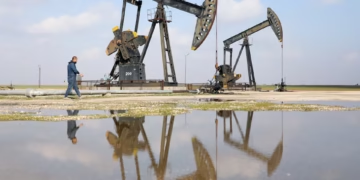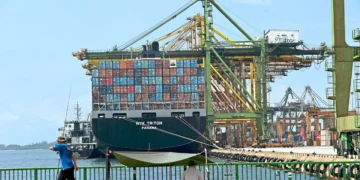
In the North Sea, where Denmark once drilled for oil, imported European carbon dioxide will soon be buried under the seabed in a carbon capture and storage (CCS) project nearing completion.
CCS technology is one of the tools approved by the UN’s Intergovernmental Panel on Climate Change (IPCC) and the International Energy Agency (IEA) to curb global warming, especially for reducing the CO₂ footprint of industries like cement and steel that are difficult to decarbonise.
But the technology is complex and costly.
Led by British chemicals giant Ineos, the Greensand project 170km (105 miles) off the Danish coast consists of a deep, empty reservoir beneath a small, windswept oil platform in the North Sea.
In its first phase, due to begin in the next few months, Greensand is slated to store 400,000 tonnes of CO₂ per year.
It’s “a very good opportunity to reverse the process: instead of extracting oil, we can now inject CO₂ into the ground,” Mads Gade, Ineos’s head of European operations, told AFP.
Liquefied CO₂ sourced mainly from biomass power plants will be shipped from Europe via the Esbjerg terminal in southwestern Denmark to the Nini platform above an empty oil reservoir, into which it will be injected.
“The reason why the North Sea is seen as a vault for CO₂ storage is because of the enormous amounts of data that we have collected through over 50 years of petroleum production,” said CCS coordinator Ann Helen Hansen at the Norwegian Offshore Directorate (Sodir).